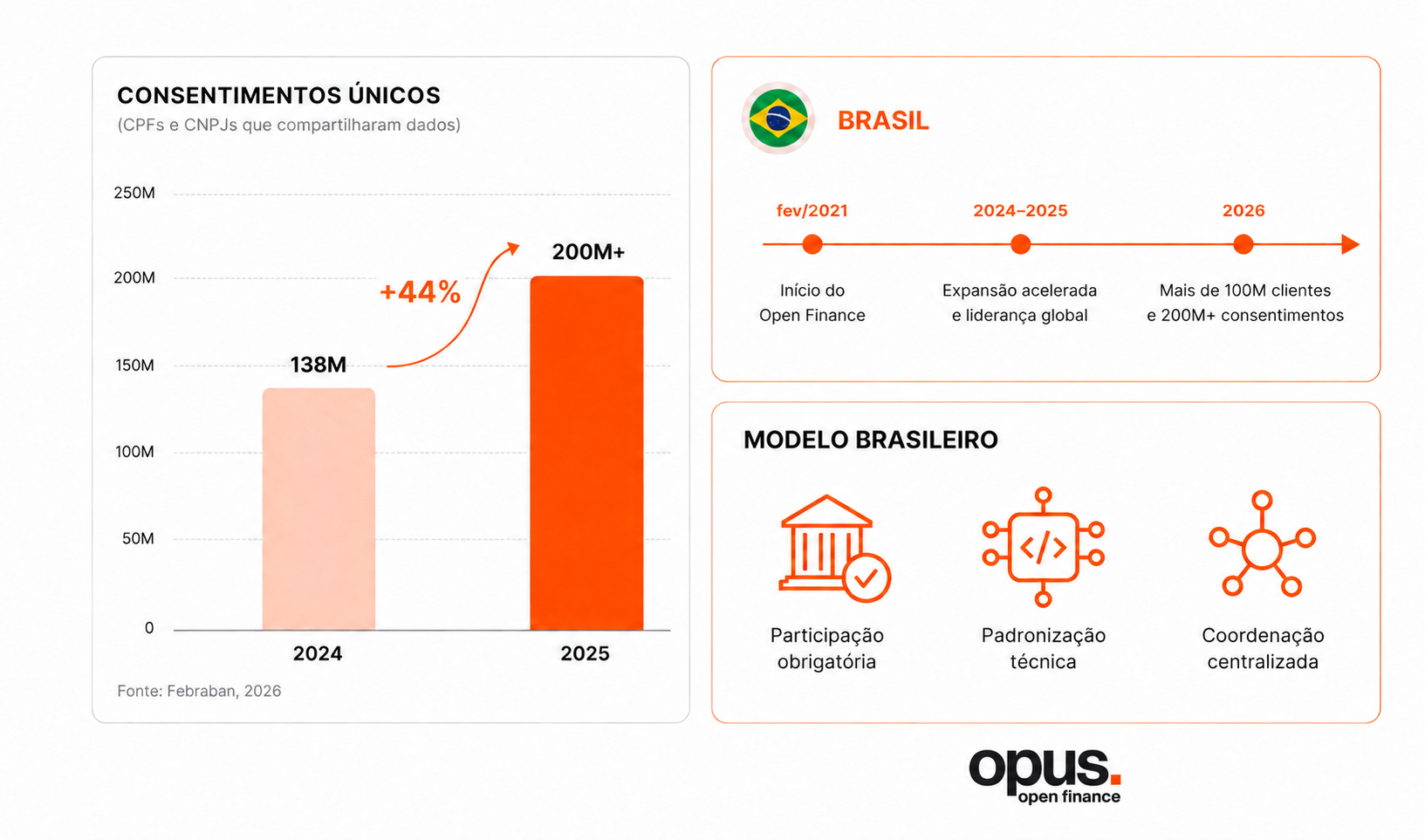
Brazil launched Open Finance in February 2021. Five years later, the country has already achieved... over 100 million connected customers e over 200 million active consents, according to official data from the company itself Open Finance Brazil.
These figures put Brazil ahead of the United Kingdom, the European Union, and any other open finance ecosystem in the world.
Even so, many institutions still treat Open Finance merely as a regulatory requirement. In practice, the transformation is much greater: Open Finance changes how banks, fintechs, and companies access data, create financial products, and develop new use cases for their clients.
Se você chegou até aqui por uma exigência regulatória ou uma decisão estratégica em avaliação, este artigo explica o essencial: what is it? Open Finance, como funciona, em que estágio Brazil is and What does this transformation mean? for institutions that are considering becoming a part of it.
Índice
Quick reference
| What is it? | How does it work? |
| An ecosystem that allows for the standardized sharing of financial data and the transfer of bank accounts between authorized institutions, always with the client's consent. | The customer consents to an institution accessing their data held by another institution or, where applicable, initiating payments and managing their accounts across different platforms via standardized APIs. |
What is Open Finance?
Um correntista liga pedindo um limite maior de cartão. A resposta vem baseada no histórico que aquele banco tem dele, que pode ser só uma fração da vida financeira real dessa pessoa. Ela também tem conta em outro banco, um cartão de crédito numa fintech e um histórico de pagamentos em dia que ninguém está vendo.
Durante décadas, os dados financeiros dos brasileiros permaneceram isolados dentro das instituições onde foram gerados. Um correntista com bom histórico no Banco A chegava ao Banco B como cliente novo, sem contexto e sem vantagem.
Credit assessment, product offering, and onboarding experience all started from scratch, even when the complete history already existed, just elsewhere.
Open Finance breaks with this logic.
Under regulation by the Central Bank, formalized by Joint Resolution No. 1/2020, Large financial institutions have been required to create standardized APIs that allow the sharing of customer data and, in certain situations, the initiation of payments and account transactions, always with the explicit consent of the customer.
The central principle is clear: The customer is the true owner of their own data and should be able to decide how it will be used and shared.
How does Open Finance work in Brazil?
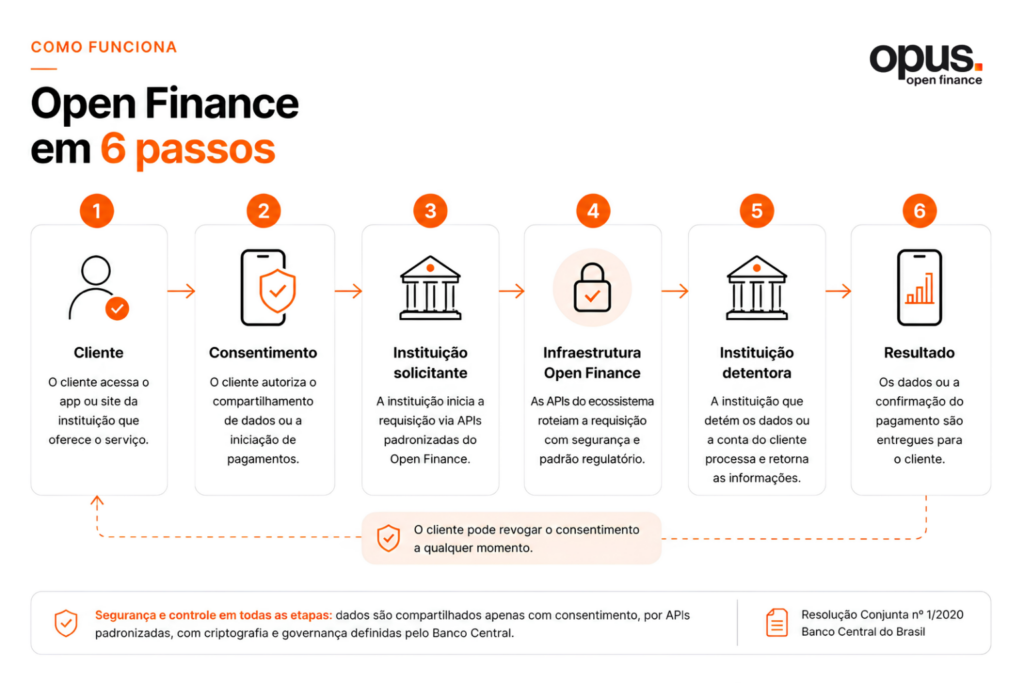
The functioning of Open Finance depends on three main elements:
1. Explicit consent
O cliente autoriza, dentro do aplicativo ou site de uma instituição, o compartilhamento de dados específicos mantidos em outra, ou a iniciação de um pagamento em seu nome.
Esse consentimento tem escopo definido, prazo limitado e pode ser revogado a qualquer momento pelo próprio cliente, com efeito imediato.
Saiba mais sobre como funciona o consentimento no Open Finance aqui →
2. Standardized APIs
Todas as instituições participantes seguem as mesmas especificações técnicas definidas pelo Open Finance Brasil, o que permite que qualquer instituição autorizada troque dados com qualquer outra, sem precisar de integração sob medida para cada novo parceiro.
3. Principle of reciprocity
According to Article 4, item V, of Joint Resolution No. 1, quem adere ao ecossistema (voluntária ou obrigatoriamente) ganha o direito de receber dados de outras instituições participantes, mas assume também a obrigação de compartilhar os próprios dados de cliente sempre que houver consentimento válido para isso.
In practice, a fintech company can, with the client's authorization, access the history of their checking account, credit card, and credit transactions held at another bank, without the client needing to gather statements or fill out forms manually.
How Open Finance changed the financial market
| Theme | Before OF | After OF |
| Control over the data | Restricted to the bank where they were generated. | Controlled by the customer |
| Financial overview | Fragmented among institutions | More consolidated |
| Account opening (onboarding) | Slow and bureaucratic | Faster and simpler |
| Credit analysis | With a partial portrait of the client. | More complete and accurate |
Open Finance vs Open Banking: what's the difference?
Those who have been following this topic for a while may remember the term "Open Banking".
On March 24, 2022, the National Monetary Council formalized the change in terminology from “Open Banking” to “Open Finance”, reflecting the broader scope of the ecosystem, which now includes information on:
- investments
- exchange
- insurance
- pension
- other financial services.
According to an official statement from the Central Bank of Brazil, The change also sought to make the initiative more friendly and in a way that is easy for the public to understand, aiming to increase customers' willingness to use the products and services offered by Open Finance.
The four phases that built the ecosystem
O Open Finance foi lançado em fevereiro de 2021 no Brasil e implementado em quatro fases, cada uma ampliando o que podia ser compartilhado.
Phase 1 — Open Data (February 1, 2021)
Institutions began publishing standardized information about their own channels, products, rates, and fees without requiring consent. The goal was to increase market transparency, allowing any system to consult and compare offers in a standardized way, with unrestricted access.
Phase 2 — Customer Data (August 13, 2021)
Mediante o consentimento do cliente, as instituições passam a compartilhar dados cadastrais e transacionais, como:
- current account history
- savings
- credit card
- credit operations
- financing
- loans
- overdraft
- receivables anticipation
This is the phase in which Open Finance begins to have real value for customized services.
Phase 3 — Initiation of Payments (October 29, 2021)
Open Finance now allows... initiation of payments via Pix from institutions that are not the account holders. In practice: paying for a purchase on a marketplace without leaving the sales environment, using funds from any bank participating in Open Finance.
Saiba mais sobre o Iniciador de Transação de Pagamentos (ITP) aqui →
Phase 4 — Ecosystem expansion (December 15, 2021)
Expansion of the scope of phases 1 and 2, to include information on:
- insurance
- private pension
- investments
- exchange
- payroll accounts
Why has Open Finance Brazil become a global benchmark?
Five years after its launch, the numbers for Brazil's Open Finance system place the country at a level that no other ecosystem of its kind has reached with the same speed.
According to data from the Citizen Dashboard of Open Finance Brazil, the country already has more than 100 million customers connected and Over 200 million active consents. Between 2024 and 2025, the number of unique consents (individual taxpayer IDs and company taxpayer IDs that effectively shared data) grew by 44%, according to the Febraban.
This advantage stems from a deliberate regulatory choice: Brazil opted for a coordinated model, with mandatory participation for the country's largest institutions (segments S1 and S2, as well as institutions with more than 5 million accounts) and centralized technical standardization from day one.
Modelos voluntários, em que cada instituição adere se quiser, tendem a avançar mais devagar.
Open Finance use cases that are already generating value.
O retorno aparece quando as instituições transformam dados compartilhados em decisões de negócio.
Three use cases already demonstrate this in practice:
1. Credit based on a proven track record.
By using data from other institutions, a fintech company or bank can assess the real financial behavior of a new customer, instead of treating them as an unknown profile just because the relationship is recent.
This includes information such as:
- Payment history
- General account statement
- Credit card bill
- Account limits
- Balance
In practice, this sharing reduces the information asymmetry that historically made credit more expensive for those without extensive banking relationships.
Saiba mais sobre Portabilidade de Crédito no Open Finance aqui →
2. Accelerated Onboarding
With data shared via Open Finance, a new institution can complete KYC and profile analysis in minutes, using information already validated by another bank.
Na prática, isso reduz etapas manuais, diminui a necessidade de preenchimento de formulários e torna a abertura de conta mais fluida, reduzindo o abandono durante o cadastro e aumentando as taxas de conversão de novos clientes.
3. Consolidated Financial Management (PFM)
O Open Finance permite consolidar, numa única interface, informações financeiras de diferentes instituições.
In practice, the client gains a more complete view of their financial life, being able to monitor:
- balances in multiple banks
- card expenses
- investments
- credit operations
- all your consolidated cash flow
How can I participate in Open Finance Brazil?
Instituições financeiras podem participar do ecossistema como um dos quatro perfis abaixo:
| Perfil | O que faz |
| Transmissor de Dados | Envia os dados do cliente para a instituição autorizada a recebê-los. |
| Data Receiver | Recebe e utiliza os dados compartilhados para oferecer produtos, crédito ou serviços personalizados. |
| Payment Initiation Service Provider (PISP) | Solicita e inicia um pagamento em nome do cliente, via Pix, sem que ele saia do ambiente onde está comprando |
| Policy Holder Institution | Instituição onde o cliente detém a conta e executa o pagamento solicitado pelo ITP. |
A participação exige infraestrutura regulatória, APIs padronizadas, gestão de consentimento auditável, monitoramento contínuo e adequação às exigências do Banco Central.
Learn more about the participation profiles here →
And what does this mean for my business?
Se a sua empresa opera no setor financeiro, o Open Finance já deixou de ser uma pauta futura.
A pergunta que vale fazer não é mais “precisamos entrar?”. A essa altura, a resposta já é sim. A questão agora é outra: como transformar essa infraestrutura em geração de valor, em vez de apenas cumprir uma exigência regulatória?
Você está enxergando seus clientes com o histórico completo deles, ou apenas com a fatia que passou pelo seu sistema?
Se seus concorrentes têm acesso ao histórico que você não tem, a sua análise de crédito, o seu onboarding e a sua personalização estão operando com informação incompleta. É justamente aí que o Open Finance deixa de ser apenas infraestrutura regulatória e passa a impactar a capacidade de competir.
Para isso, porém, é preciso uma operação preparada: APIs no padrão do Banco Central, gestão de consentimento auditável, segurança de dados e capacidade de evoluir junto com um sistema que ainda está em expansão
A diferença entre a instituição que usa Open Finance como obrigação e a que usa como oportunidade não está no tamanho. Está na escolha de como montar a operação.
Por que essa mudança vai além da regulação?
The growth of Open Finance in Brazil is not solely due to regulatory obligations. The advancement of the ecosystem also reflects a broader shift in how financial data can improve access, experience, and competitiveness within the financial system.
“None of us bet on this for sport. We believe it will work because we have hope that it will truly improve the lives of ordinary citizens at the grassroots level. It's the kind of thing that makes you get up early, you know? Saying: 'Well, I'm going to take another step towards a day when people, without even knowing what Open Finance is, will have improved access to the financial system as a whole and will learn to use money more responsibly.'‘

Ouça mais em Let’s Money #005: Portabilidade de Crédito 2.0 com Francisco Barguil →
How can Opus help?
Capturing real value from Open Finance requires a technical layer that goes beyond "having a working API": it demands a proprietary authorization server, consent management, a metrics collection platform (PCM), a data quality engine (MQD), and ongoing support in a frequently changing ecosystem.
Opus Open Finance delivers this infrastructure as a modular platform for fintechs and banks that want to operate in Open Finance. without having to build everything from scratch.
They are mais de 35 anos with expertise in mission-critical systems, with a subdivision dedicated exclusively to Open Finance.
Do you want to understand how this would work in Your business? Talk to the Opus Open Finance team →

FAQ
What is Open Finance?
Open Finance is an ecosystem regulated by the Central Bank that allows, with the explicit consent of the client, the sharing of financial data between authorized institutions and the initiation of payments through different platforms.
What is the difference between Open Finance and Open Banking?
Open Finance This is the new nomenclature for Open Banking, adopted by the Central Bank of Brazil to make the concept more user-friendly and reflect the expansion of the initiative to investments, foreign exchange, insurance, pensions, and other financial products and services.
Is Open Finance mandatory for all financial institutions?
No. The requirement depends on the size and regulatory profile of the institution.
Which institutions are required to participate in Open Finance?
Institutions in segments S1 and S2, and institutions with more than 5 million accounts, are required to participate as data transmitters.
Instituições com perfil obrigatório no Pix e mais de 500 mil contas ativa são obrigadas a participar como detentora de conta, liquidando pagamentos iniciados por ITP.
What are S1 and S2?
São categorias regulatórias do Banco Central que classificam instituições financeiras por porte, relevância e impacto potencial sobre a estabilidade do sistema financeiro.
The segment S1 It brings together the largest financial institutions in the country, with a size equal to or greater than 10% of GDP or significant international operations.
The S2 segment It includes large financial institutions with assets exceeding 11 times the GDP of the third quarter, but without global systemic relevance.
Is it possible to participate in Open Finance voluntarily?
Yes. Institutions that do not meet the mandatory criteria can voluntarily join the Open Finance Brazil ecosystem.
Why is Brazil a global leader in Open Finance?
Through a combination of mandatory requirements (all major players are required to join), centralized technical standardization from the outset, and speed of adoption (100 million customers in less than five years).
Voluntary models like the British one took much longer to reach a comparable scale.
What is consent in Open Finance and how does it work?
Consent is the explicit authorization that a customer gives for institutions participating in Open Finance to share their financial data and, when applicable, initiate payments and manage their bank accounts.
Ele tem escopo definido pelo cliente (quais dados ou serviços serão autorizados), prazo renovável e pode ser revogado a qualquer momento, com registro e rastreabilidade seguindo os padrões técnicos do Banco Central.
How does Open Finance help with credit?
O compartilhamento de dados financeiros permite análises de crédito mais completas e personalizadas, reduzindo a assimetria de informação que hoje encarece o crédito para quem tem relacionamento bancário mais recente.
Por onde uma fintech ou banco começa a operar no Open Finance?
O primeiro passo é definir em qual perfil do ecossistema a instituição vai atuar (Transmissor, Receptor, Detentor de Conta ou ITP), porque isso determina quais APIs e quais exigências regulatórias se aplicam.
A partir daí, entra a construção ou contratação da infraestrutura técnica: servidor de autorização, gestão de consentimento e conformidade contínua com o Banco Central.
Conclusion
O Open Finance in Brazil It is no longer just a regulatory obligation. to become a strategic infrastructure of the financial system.
By enabling the secure sharing of data with customer consent, the model creates new possibilities for credit, personalization, onboarding, and the development of financial products.
More than just meeting the regulatory requirements of the Central Bank, participating in the Open Finance ecosystem means competing in a market that is increasingly driven by data, interoperability, and customer experience.
Institutions that use Open Finance strategically tend to accelerate innovation, expand their analytical capacity, and... to create sustainable competitive advantages.
For banks, fintechs, and other ecosystem participants, The question is no longer whether they should participate in Open Finance., but yes How to transform this infrastructure into value creation for the business.. And the first step toward that is structuring an operation capable of combining regulatory compliance, security, and scalability from day one.